

Insulated vs Non-Insulated Flexible Ducting | Buyer's Guide
Whether you're installing a kitchen, bathroom, or commercial ventilation system, choosing the wrong ducting can cost you higher energy bills, condensation problems, and poor air quality. Here's how to get it right the first time.
What is Flexible Ducting — and Why Does it Matter?
Flexible ducting (sometimes called a flex duct or ducting pipe) is the workhorse of any ventilation system. Unlike rigid sheet metal runs, it bends around joists, fits into awkward spaces, and connects fans and grilles without a straight-line path. That flexibility makes installation faster and more forgiving.
But "flexible" isn't the only decision you'll make. The bigger question is whether your application calls for insulated or plain, uninsulated ducting — and the answer depends on where the duct runs, what's around it, and what it needs to do.
Insulated vs Non-Insulated - The Differences
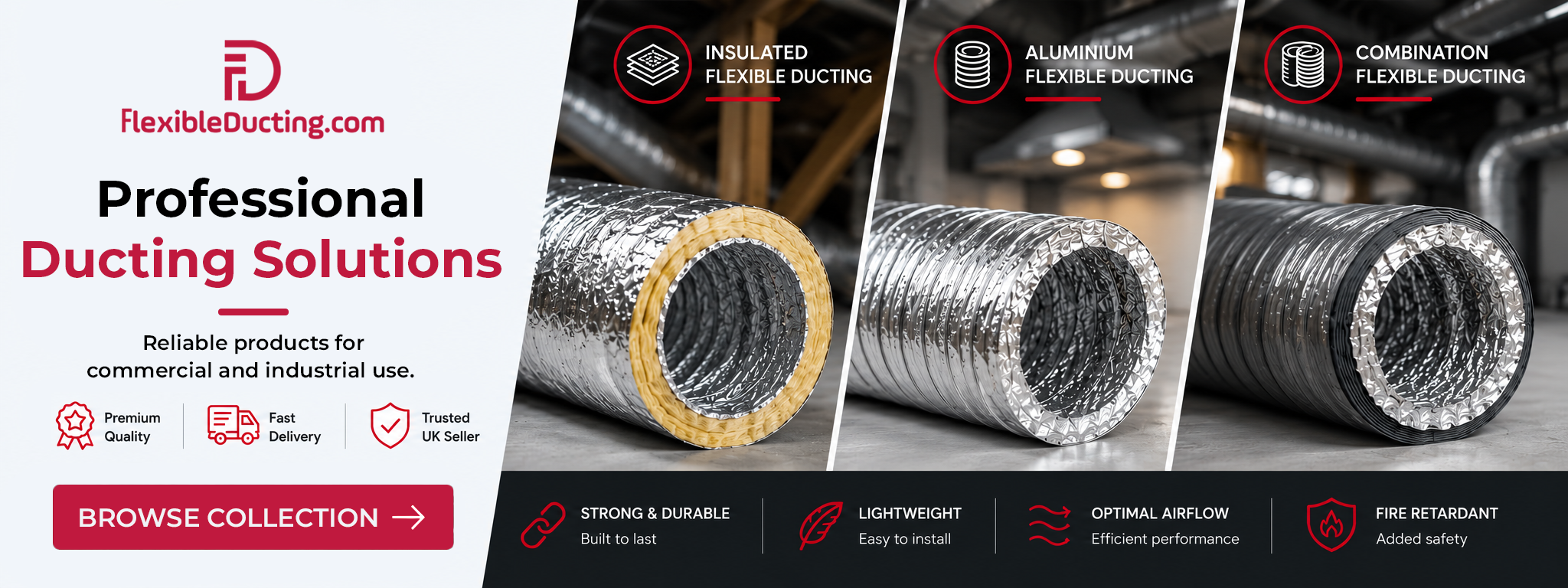
Both types share the same inner core — a wire-supported aluminium or foil liner that carries air from A to B. The difference is what's wrapped around it.
|
Non-insulated Standard flexible ducting |
|
|
|
When Do You Need Insulated Air Ducting?
Ducting insulation or ventilation accessories aren't always necessary — but when they are, skipping them causes real problems. Here are the situations where insulated air ducting earns its place:
- Runs through cold or unheated spaces
If your duct pipe travels through a loft, crawl space, garage, or any area that isn't temperature-controlled, the air inside will lose heat (or gain it in summer). Insulated ducting keeps conditioned air at the right temperature from the fan to the grille.
- Condensation-prone environments
When warm, humid air moves through a cold duct, moisture forms on the outer surface — and eventually inside the duct wrap wall. That leads to mould, water damage, and ultimately a failed installation. The vapour barrier on the insulated flexible duct prevents this process from starting.
- HVAC and heat recovery systems
In any system where maintaining precise air temperatures matters — MVHR (mechanical ventilation with heat recovery) units, air conditioning distribution, or commercial HVAC (Heating, Ventilation, Air Conditioning) — ductwork insulation is almost always required by design specification.
- Acoustic performance
The insulation layer also dampens sound. If your flexible ducting runs near bedrooms, meeting rooms, or any noise-sensitive space, insulated ducting reduces both airborne and structure-borne noise transmission.
Quick Factors Comparison: Insulated vs Non-Insulated Flexible Ducting
|
Factor |
Non-Insulated flexible ducting |
|
|
Thermal performance |
Retains air temperature |
No thermal protection |
|
Condensation control |
Vapour barrier prevents surface moisture |
Condensation risk in cold environments |
|
Acoustic dampening |
Reduces noise transmission |
No acoustic benefit |
|
Cost |
Higher per metre |
Lower per metre |
|
Weight & bulk |
Heavier, larger outer diameter |
Lighter, more compact |
|
Best for |
Lofts, unheated voids, HVAC, MVHR, long runs |
Short internal runs, bathroom & kitchen extraction |
FAQ’s
1. What is the difference between insulated & non-insulated flexible ducting?
Standard flexible ducting is a plain inner liner that carries air from one point to another. Insulated flexible ducting wraps that inner liner in a thermal material — usually glass wool or mineral wool — and then seals it with a vapour barrier jacket. The insulation reduces heat loss, prevents condensation from forming on the outside of the duct, and adds a degree of acoustic dampening.
2. Can I use standard flexible ducting for bathroom ventilation?
It depends on the route. If the duct runs a short distance through a heated, conditioned space to an external wall, standard flexible ducting is usually fine. If any part of the run passes through an unheated void, ceiling space, or loft — even briefly — you should use insulated flexible duct to prevent condensation and mould build-up inside the ductwork.
3. What size does the insulated flexible duct come in?
Insulated flexible duct is available in the same core diameters as standard flexible ducting — typically 100mm, 125mm, 150mm, 200mm, and 250mm for domestic and light commercial use. The outer diameter will be larger due to the insulation wrap, which is usually 25mm thick as standard. Always measure your route clearance based on the outer diameter, not the inner.
4. Can ducting insulation be added after installation?
Technically, yes — insulation lagging can be wrapped around existing duct pipe. In practice, this is much harder than fitting an insulated flexible duct from the start, particularly in confined spaces. If there's any doubt about whether your run will need insulation, fit insulated ducting during installation. It's a small cost difference upfront and a significant saving compared to remedial work later.