

Ventilation Guide 2026 | Role of Ducting & Best Practices
Good ventilation is essential to maintaining a comfortable, healthy indoor environment. Whether in a home, workplace or commercial building, ventilation helps remove stale, humid and polluted air while allowing fresh air to enter.
But how does that air actually move around a building? This is where ventilation systems, fans, vents and ducting work together. Flexible ducting can play an important role in connecting these components and creating an effective route for air to travel, particularly where ductwork needs to navigate bends, corners or restricted spaces.
In this guide, we explain what ventilation is, how ventilation systems work, the role of ducting, and where flexible ducting can support effective airflow.
What Is Ventilation and Why Is It Important?
Ventilation is the process of removing unwanted indoor air and replacing it with fresh outdoor air. A well-designed ventilation system can help control moisture, odours, airborne pollutants, and excess humidity while improving overall air movement in a building.
Everyday activities such as cooking, showering, and drying clothes can increase indoor moisture levels; without adequate ventilation, this moisture can contribute to condensation and create an uncomfortable indoor environment.
Ventilation can be achieved naturally through windows, vents, and other openings, or mechanically with fan-based ventilation units and ductwork.
For many modern homes and commercial buildings, mechanical ventilation provides a more controlled way of moving air to specific areas, to an external outlet, or into the supply where it is needed.
How Does a Ventilation System Work?
An air ventilation system typically works by creating a controlled path for air to enter, move through or leave a building.
Depending on the type of system, this may involve:
- Extracting stale or humid air from a room
- Bringing fresh air into an indoor space
- Moving air between different areas
- Passing air through filters or ventilation equipment
- Discharging extracted air through an external outlet
Fans or ventilation units provide the force needed to move air, while vents provide entry or exit points. Ducting provides the route between these components.
For example, an extraction system may draw air from a room through a vent, move it through a length of ducting and discharge it outside. The system's effectiveness depends on the ventilation equipment, duct route, and how the ducting is installed.
This makes choosing and installing ventilation ducting an important part of the overall system.
What Is Ducting for Ventilation?
Ducting transports air from one location to another within a ventilation system. It can connect fans, ventilation units, vents and external outlets, creating a continuous route for air movement.
Ventilation ducting comes in different materials, sizes and constructions to suit different applications. The right choice depends on factors such as the type of ventilation system, airflow requirements, installation environment and available space.
Ducting may need to pass through ceilings, walls, cupboards, loft spaces or other areas where the route is not always completely straight. This is one situation where flexible ducting can be particularly useful.
What Is Flexible Ducting?
Flexible ducting is a type of ductwork designed to bend and adapt to the route required by a ventilation or air extraction system.
Unlike a rigid duct, flexible ducting can be routed around obstacles and through spaces where a completely straight duct run may not be practical. It can also connect ventilation components where installation requires flexibility.
Flexible ducting is available in a range of sizes, diameters, and materials, including combination, aluminium, and insulated & non-insulated options for applications where insulation is required.
The appropriate type depends on the ventilation system and the conditions in which the ducting will be installed.
Suggested Read: Flexible Ducting & Ventilation Accessories - UK Buyer's Guide
What Role Does Flexible Ducting Play in Ventilation?
Flexible ducting can provide a practical route for moving air between ventilation components. Its flexibility makes it useful where the duct run needs to change direction or work around existing structures.
For example, a ventilation system may need ducting to pass around a beam, through a confined area or towards an external vent. Flexible ducting can make these routes easier to accommodate.
It can be used to:
- Connect ventilation fans and vents
- Route extracted air towards an external outlet
- Navigate bends and awkward spaces
- Connect different components within an air ventilation system
- Create duct runs where rigid routes may be difficult to accommodate
However, flexibility does not mean the duct should simply be bent or compressed into any available space. The duct route still needs careful planning to ensure effective airflow.
What Types of Flexible Ducting Can Be Used for Ventilation?
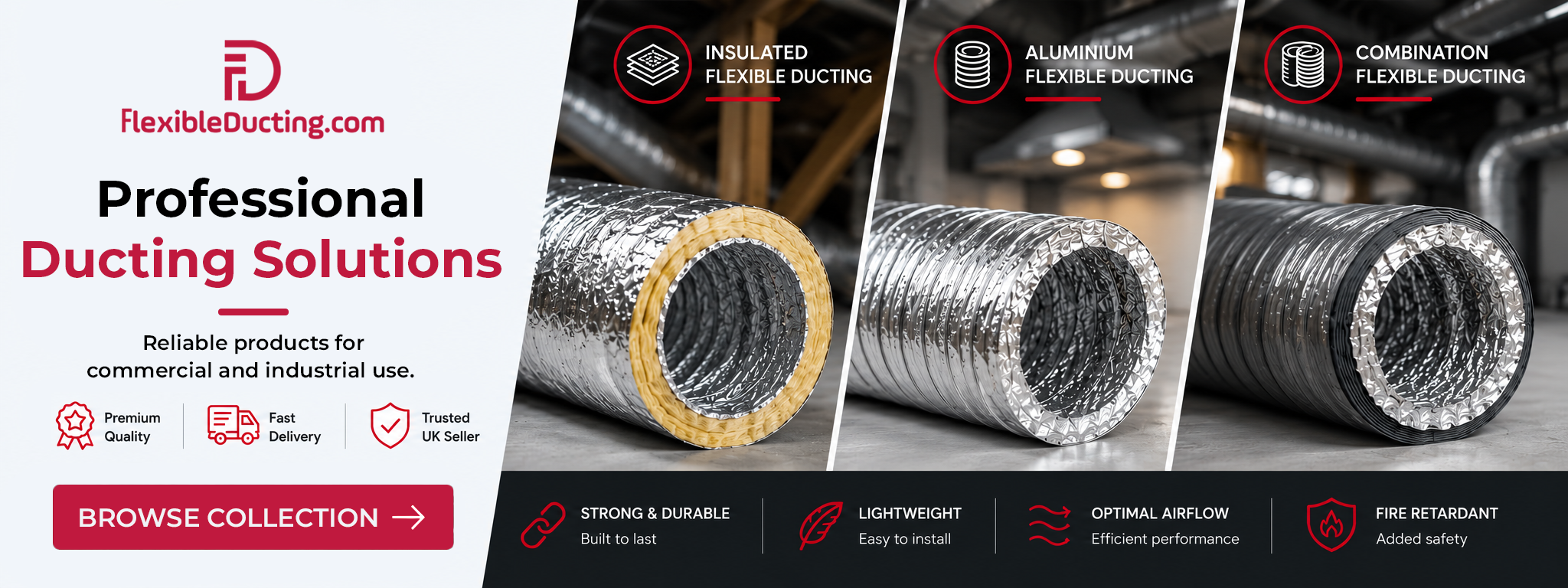
The right flexible ducting depends on the ventilation application's requirements. Common options include aluminium, PVC and insulated flexible ducting.
Aluminium flexible ducting is commonly used for air movement and extraction applications. Its flexible construction lets you route it around obstacles while providing a suitable ducted path between ventilation components.
Different diameters are available, so select the size based on the ventilation system's requirements.
Combination flexible ducting combines different materials or layers to balance flexibility, strength, and performance. Depending on the construction, it can suit ventilation and air extraction applications that require a more robust or versatile ducting solution.
It can be useful where ducting needs to accommodate bends and directional changes while maintaining a practical connection between ventilation components. Always check the product specifications to ensure the duct suits your ventilation system and operating conditions.
Insulated flexible ducting incorporates an insulating layer around the duct. Depending on the application, this can help with temperature control and reduce the risk of condensation forming on the outside of the duct.
Insulated flexible ducts can be particularly useful where ductwork passes through areas with different temperatures or where thermal performance is an important consideration.
What Size Flexible Ducting Do You Need for Ventilation?
The required duct diameter depends on the ventilation equipment, required airflow and system design.
Flexible ducting is available in several diameters, including commonly used sizes such as 100mm and 125mm. However, the largest available size is not automatically the best option.
The duct diameter should match the fan, vent, or ventilation unit it connects to. Reducing the diameter unnecessarily can restrict airflow, while an unsuitable duct size may prevent components from connecting correctly.
Always check the ventilation equipment requirements before choosing a duct diameter.
Where Can Flexible Ducting Be Used for Ventilation?
Flexible ducting can be used across a range of ventilation and air extraction applications where its flexibility is beneficial.
- Residential Ventilation
In homes, ventilation ducting can move air between rooms, fans, and external outlets. Flexible ducting can be particularly useful when installation routes need to work around existing structures.
- Bathroom and Moisture-Prone Areas
Ventilation helps remove humid air generated by activities such as showering and bathing. Flexible ducting can be used in suitable extraction systems to route air from the ventilation fan to a terminal outlet.
- Kitchen Ventilation
Kitchen ventilation systems can remove moisture, odours and airborne particles generated during cooking. Flexible ducting may be used within suitable extraction arrangements where the duct route requires flexibility.
- Loft and Roof Spaces
Ventilation ducting may need to pass through lofts or roof spaces where structural elements can make routing more difficult. Flexible ducting can help accommodate these routes when selected and installed correctly.
- Commercial Air Ventilation
Commercial buildings can have more complex ventilation requirements, with ducting connecting ventilation equipment to different areas of a building. The right ducting depends on the system design, airflow requirements, and environment.
Suggested Read: Benefits of Using Flexible Ducting in Homes & Industry
How to Get Better Performance from Ventilation Ducting?
Correct installation is just as important as choosing the right ducting.
To help maintain effective airflow:
- Keep duct runs as short as reasonably practical.
- Avoid unnecessary bends and direction changes.
- Prevent flexible ducting from becoming too tight; keep the duct as straight as practical.
- Make sure connections are secure.
- Seal connections appropriately to prevent unwanted air leakage.
- Support ducting where necessary, particularly across longer runs.
- Use the correct duct diameter for the ventilation equipment.
Flexible ducting is designed to make routing easier, but excessive bending, compression or poor installation can reduce the effectiveness of the ventilation system.
Can Flexible Ducting Improve a Ventilation Installation?
Flexible ducting can make certain ventilation installations easier because it can adapt to the available route. This is particularly useful when ductwork needs to navigate around obstacles or connect components that are not perfectly aligned.
However, a ventilation system's performance depends on the complete installation, not the ducting alone. The fan or ventilation unit, duct diameter, duct length, number of bends, connections, and external outlet all affect how effectively air moves through the system.
The aim should therefore be to choose flexible ducting suitable for the application and install it to keep the airflow path as clear and efficient as possible.
FAQs
1. Can flexible ducting be used for ventilation?
Yes. Flexible ducting is used in suitable ventilation and air extraction systems to connect fans, vents, ventilation units and external outlets. The correct type, diameter and installation method depend on the specific application.
2. What is flexible ducting used for?
Flexible ducting transports air in ventilation, extraction, and other suitable air-movement systems. Its flexibility makes it useful where ductwork needs to navigate bends, obstacles or restricted spaces.
3. What size flexible ducting is used for ventilation?
Common sizes include 100mm and 125mm, but the correct diameter depends on the ventilation equipment and required airflow. Always check the specifications of the connected fan, vent or ventilation unit.
4. Is insulated flexible ducting suitable for ventilation?
Insulated flexible ducting can be suitable for ventilation applications that require insulation. It can help manage temperature differences and reduce the risk of condensation on the outside of the duct.
5. Is aluminium flexible ducting suitable for ventilation?
Aluminium flexible ducting can suit a range of ventilation and air extraction applications. Select the right product based on system requirements, operating conditions, and the installation environment.
6. Does flexible ducting affect ventilation airflow?
Ducting is only one part of the ventilation system. Airflow can be affected by factors such as duct diameter, length, bends, kinks, compression and connections. Correct sizing and installation can help the system operate effectively.
7. Where can flexible ducting be used?
Flexible ducting can be used in suitable residential and commercial ventilation applications, including air extraction, bathroom ventilation, kitchen ventilation, loft spaces and other systems where flexible routing is required.